
Wednesday, August 24, 2011

Saturday, June 11, 2011

Monday, May 16, 2011
Phoenuts as weeds

Here is an accidental tip for growing fantastically huge peanuts: Let the unharvested seeds that are left behind in the soil season over in the original bed. The ones left behind from Feb 2010 are sprouting all over the place, defying severe neglect. The nuts are great, too!

Sunday, September 19, 2010
Clubbing
Warning: The following picture may be inappropriate for Sensitive Golfers.

Saturday, June 19, 2010
Food Bank Visits the Compound


St Mary's Food Bank Alliance's Linnaea Hudson and Elizabeth Hunch pick peas in Diane and Linda's garden.
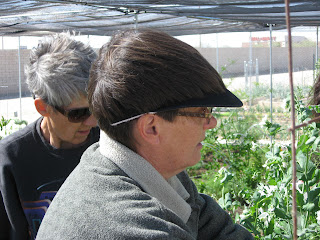 Food bank volunteers and all-around great gardeners, Diane and Linda share their bounty with those less fortunate.
Wednesday, June 2, 2010


Wednesday, May 26, 2010
Hot and Breezy

Cocktails among the sunflower stalks with Dottie Johnson, John, Gene Johnson and Ruthie Korb.

Thursday, February 11, 2010
Crushin' Cans
By request, I've added a very amateurish video I took last year. It demonstrates the Sun City West Way to crush pop cans. You'll get the gist.
Wednesday, February 10, 2010
Diggin' spuds

I love to eat potatoes. Never grew them, tho. The planting season here starts January through February, with 90-120 days til harvest. So when I read a blurp in the paper that potato seeds were available at the local garden center, I jumped at the opportunity to cultivate my own patch of paradise. Why buy potato seeds when any ol supermarket tuber is one sprout away from taking over the veggie bin? Two reasons: if it doesn't sprout, it is probably because the plant was treated with a growth inhibitor. In addition, seeds are certified as resistant to most common diseases. There were 6 varieties of potatoes to choose from at the nursery, in 5 lb bags. I picked “Pontiac Red,” based solely on the yummy picture on the label.
The planting bed was perfection. Nothing had grown in it since I dug in nitrogen-rich soybean plants in September. I then over-wintered a large pile of aged horse manure. The clincher was that the soil had never known disease-prone crops from the nightshade family. No (Irish) potato blight here, knock on wood.Planting took place yesterday, with a promise of rain today. Perhaps I should start a few chives to compliment the harvest. . . .
Tuesday, February 9, 2010
Phoenuts
 (Even though the post date says Feb 2010, the actual plant -harvest dates were July through October 2009).
What can be better in the heat of the desert summer than a lush bed of nitrogen-rich peanut plants? The "seeds" were bought at the local natural food store as raw peanuts (in the shell). Planted without the shell but with the red skin intact, they all sprouted quite quickly.

Pretty, pea-like flowers.
 The flower sends out (down) a "peg" -a sort of modified root which grows a peanut when it makes contact with the right soil conditions. The red circle indicates the fading flower at the tip of the downward-growing peg.
A bountiful harvest.
Wednesday, July 22, 2009
The Rest of the Story


 Cinderella pumpkin, from a volunteer seed in a composted pile, took over the NW corner of the garden and thrived all spring and into the summer.
 Cucuzza, parte due

Santi had to prove to me that his '03 Illinois-grown cucuzza was a record-breaker. He eventually had to dig a hole for the far left plant so that it could grow another 1.5 feet (the pergola was about 9').

Three cheers for vaulted ceilings!
Friday, July 10, 2009

Wednesday, July 8, 2009
Cucuzza Santi
 This gourd, which tastes and looks more like the squash commonly known as zucchini, is "Sicilian cucuzza". It grows on a downy-soft vine that seems to love the desert heat. But the truly delightful feature is that cucuzza is Italian for "crazy". Now, that's cucuzza, man.
Friday, June 19, 2009
Favorite question
Gardening is about sharing information. When another gardener asks me a question, I try to be informative and sincere.
Cranky "Mr. McGregor" honored me by asking about some of my plantings. He threw me for a loop, though, when he pointed to one bed, which I informed him were peanuts. His shocked reply was, "NO, are you sure?"
Saturday, June 13, 2009
From neonatal ward to backyard hammock
 Infant watermelon "Moon and Stars" looking quite pubescent (as hairy as a new-born monkey).
. . . a few weeks later . . .

. . . now well, um . . . supported!
Sunday, May 31, 2009
Cold Compost
 Can you find the watermelon plant? Hint: it is the small. solitary leaf, deeply lobed, amongst this over-run bed of squash vines. The end of the watermelon vine, with two tendrils, is rising out, at lower center. I planted "Ice Box" watermelon seeds several weeks before the squash took over this bed.
Before being designated for watermelon, this bed was a dumping ground for plant waste. My composting method, along with most gardeners here at the club, is cold composting. A hole or trench is dug in a fallow bed and vegetative matter is laid in the hole, covered up, and left to decay. It is a nice lazy way to add some organic matter to the soil.
The squash seeds weren't affected by the composting process (in hot composting, the pile gets so hot that all seeds are essentially cooked beyond the ability to germinate). I would have pulled the squash when it first appeared, but I was curious to know what type it was (we eat and compost a variety of squash). I was able to identify this uber-grower when I found a female flower/fruit on a vine today. It came from a French pumpkin called "Cinderella" that was left to molder last fall. The jack-o-lantern sat on top of the bed for about 2 months, refusing to decay, so I ended up taking a shovel to it and breaking it up that way. The pulp of the pumpkin provided the seed with enough moisture and nutrition to get it sprouting.
So here's the infant pumpkin, still sporting its closed and yet-to-be-pollinated female flower. It is about 1" in diameter. Kinda looks like an upside down ice cream cone. I sunk a Japanese garden knife behind the "little guy" for scale and I will chronicle the development of this pumpkin in future posts. And yes, it is absurdly early for starting pumpkins. Lets see what happens, anyway.

Saturday, May 30, 2009
Plant freaks are my peeps, part II
 Santi's grandson isn't exaggerating!
 Dear friend Ellie is put to work harvesting orange beets.
"Double-Dug"Al hums while he works! A real treat.

Janet savors an artichoke gone to flower
Subscribe to:
Posts (Atom)